How to make a habit stick: a plan for weeks 1 to 8
Short answer: a habit sticks when the same cue starts the same small action, day after day, until you no longer decide to do it. Pick one habit, attach it to a moment you already have every day, make it small enough for your worst normal day, and plan for the stretch between week 2 and week 8, when it still takes effort and nothing seems to be happening. That stretch is where most habits die.
Most habit advice is written for day one. Find your why, get excited, buy the notebook. Day one is not the problem. Nobody quits a habit on day one. People quit around week three, when the novelty is gone and the habit is not automatic yet. This page is a plan for that week.
What "sticking" actually means
In habit research, a habit is not something you do often. It is something a cue starts for you. Benjamin Gardner, Phillippa Lally and Jane Wardle call the process "context-dependent repetition": do the same thing in the same situation enough times, and the situation starts doing the deciding.
You do not decide to brush your teeth. Standing at the sink at night decides for you. A plan to "exercise more" has no sink. It is an intention with no trigger, which is why it fades.
The curve that explains why week three is hard
In 2010, Lally and colleagues at University College London asked 96 volunteers to pick one new daily behavior, do it in the same situation every day for 12 weeks, and rate each day how automatic it felt.
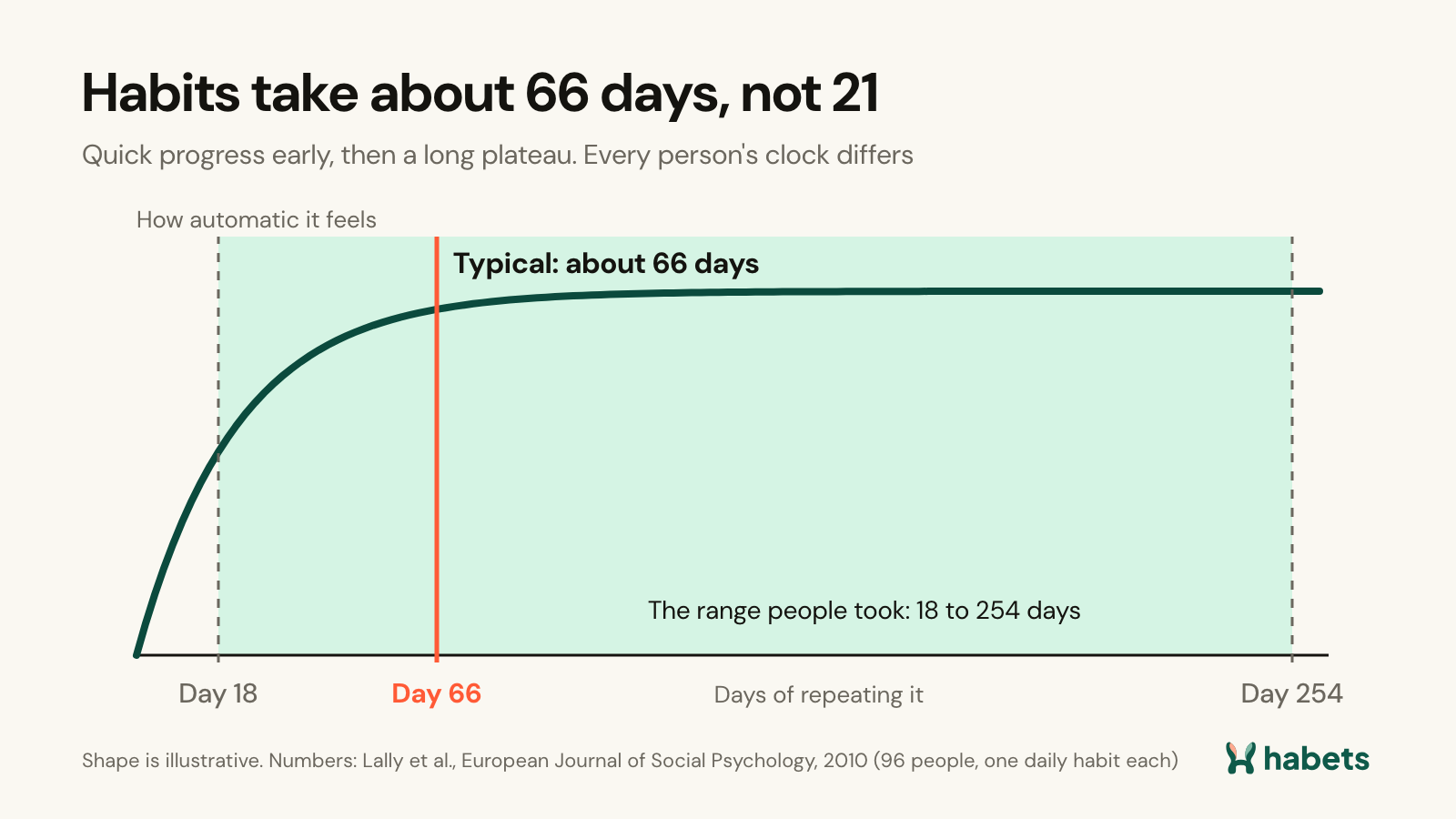
Three results matter:
- The typical time to reach the plateau was about 66 days, with a range of 18 to 254. Drinking water got there faster than exercise did. A 2024 review by Balpreet Singh and colleagues put most health habits at two to five months.
- The early repetitions did the most work. Automaticity rose fastest at the start, then flattened. So the middle weeks feel like nothing is happening, even when the habit is still forming.
- Missing one day did not seriously set people back. The habit kept building once they picked it up again.
Read those together and you get the real problem. The weeks when the habit needs you most are the weeks when it gives you the least back. Our free habit formation calculator shows the likely date your habit starts to feel automatic, so you know how long that stretch is for you.
Step 1: pick the habit (five questions)
Most people pick their first habit by how impressive the result would be. Pick it by how repeatable the action is. Run each candidate through these questions; the one with the most clear yeses is your first habit.
- Do I want this, or do I think I should? "I sleep badly and I am tired of it" has fuel. "Everyone says I should journal" does not.
- Is it something to start, not something to stop? In a 2020 study of 1,066 people's New Year's resolutions, 58.9% of people with "start" goals said they succeeded at one year, compared with 47.1% with "stop" goals. You cannot repeat not doing something until it becomes automatic. If you want to stop a behavior, choose what you will do instead, and make that the habit.
- Is there a moment I already have every day to attach it to? The first coffee, parking at work, closing the laptop, brushing your teeth at night.
- Can I do the smallest version on my worst normal day? Bad sleep, late meeting, rain. If the answer is no, shrink it. Ten minutes, not forty. Lights off by 11:30, not a whole evening routine.
- Can I check whether I did it? "Be healthier" cannot be checked. "Walk 20 minutes after lunch" can. A 2016 meta-analysis of 138 studies by Benjamin Harkin and colleagues found that monitoring progress helps people reach goals, and more so when the progress is physically recorded.
Three first habits that usually pass all five: a walk after a meal you always eat (our steps a day by age calculator helps size it), a fixed bedtime worked back from your alarm (the sleep calculator does the maths), or a set number of gym visits on fixed days.
Step 2: write the cue as one sentence
"After [moment], I will [habit] in [place]." Researchers call this an implementation intention. A 2006 meta-analysis by Peter Gollwitzer and Paschal Sheeran, covering 94 independent tests, found that people who wrote if-then plans reached their goals more often than people who only set the goal. Later work suggests the effect is smaller than that first estimate. It still costs you one sentence.
The cue should be a moment, not a clock time, when your days move around. "After I close my laptop" survives a meeting that runs late. "At 6 p.m." does not.
Step 3: make the first version embarrassingly small
The goal of the first two weeks is not results. It is repetitions in the same context. A 10-minute walk done every day builds more habit than a one-hour walk done twice, because the first gives the cue 14 chances to stick and the second gives it 2. You can grow it once it starts on its own.
Step 4: record it somewhere you will see it
A tick on a paper calendar on the fridge counts. So does data your phone already collects. The point is not the tracking itself. It is that on day 19, when nothing feels different, you can see 18 days that happened.
Step 5: decide the miss rule now
You will miss a day. Decide today what happens next: the smallest version at the next normal opportunity, no catch-up, no double session. One miss does not matter in the research. A run of misses does. More on that in what to do when a streak breaks.
What to expect, week by week
Based on the shape of the Lally curve. Your dates will differ; the order usually does not.
- Weeks 1 to 2: effort every time. You remember on purpose, or you forget. This is where most of the habit actually gets built, which is unfair, because it feels like nothing.
- Weeks 3 to 6: the danger zone. Some days it starts without thinking, some days it does not. Motivation from the start is gone. Do not judge the habit by the bad days. This is the stretch where outside structure helps most: a friend who checks in, a public commitment, or something you lose if you stop. We look at what the experiments found in commitment devices.
- Weeks 7 to 12 and beyond: simple habits often feel automatic by now. Exercise and other complex habits can take longer. Keep the cue the same.
When you notice you did it without deciding to, that is your signal to add the next habit or grow this one.
The two-minute worksheet
Copy it into your notes.
- The habit, as something to start: ____
- "After ____, I will ____ in ____."
- The smallest version for a bad day: ____
- How I will check it: ____
- What I do the day after a miss: ____
- The date I judge it by (about 10 weeks from today): ____
Then do the small version today. Not Monday. Today.
The takeaway
Habits stick through boring repetition in a stable situation, not inspiration. One habit, one cue written as a sentence, a small first version, a visible record and a miss rule will beat any amount of motivation. And give it months: the 21-day figure comes from a 1960 book about plastic-surgery patients, not from habit research.
Habets is an app for building habits through challenges your phone can verify: walking, sleep and the gym first, more habits later. The app is coming soon. If a little outside structure for weeks 3 to 6 sounds useful, join the waitlist below.
General information, not medical advice.
Questions people ask
Repeating the same action in the same situation until the situation starts the action for you. Habit research calls this context-dependent repetition. Motivation helps you start; the cue and the repetition are what keep it going.
One you actually want, phrased as something to start rather than stop, that fits a moment you already have every day, that you can do on a bad day, and that you can check. Start one, and add the next once the first runs on its own.
Goals framed as starting something tend to do better. In a 2020 study of 1,066 people's New Year's resolutions, 58.9% of those with 'start' goals said they succeeded at one year, compared with 47.1% of those with 'stop' goals.
In the best-known habit study, missing one day did not seriously set people back. Do the smallest version at the next normal opportunity and do not try to catch up. Two misses in a row is the pattern to avoid.

Build it with a little outside structure
Habets is an app for building habits through challenges your phone can verify: walking, sleep and the gym first, more later. Join the waitlist and we’ll tell you when it’s out.
We’ll only email you about the Habets launch. Unsubscribe anytime.
Sources
- Lally P, van Jaarsveld CHM, Potts HWW, Wardle J. How are habits formed: modelling habit formation in the real world. European Journal of Social Psychology, 2010
- Gardner B, Lally P, Wardle J. Making health habitual: the psychology of habit-formation and general practice. British Journal of General Practice, 2012
- Singh B et al. Time to form a habit: a systematic review and meta-analysis of health behaviour habit formation and its determinants. Healthcare, 2024
- Oscarsson M, Carlbring P, Andersson G, Rozental A. A large-scale experiment on New Year's resolutions: approach-oriented goals are more successful than avoidance-oriented goals. PLOS ONE, 2020
- Gollwitzer PM, Sheeran P. Implementation intentions and goal achievement: a meta-analysis of effects and processes. Advances in Experimental Social Psychology, 2006
- Harkin B et al. Does monitoring goal progress promote goal attainment? A meta-analysis of the experimental evidence. Psychological Bulletin, 2016