Where 10,000 steps a day came from (and what to aim for)
Short answer: 10,000 steps a day started as a product name. A pedometer sold in Japan in 1965 was called Manpo-kei, roughly "10,000-step meter", and the round number stuck. Recent large studies suggest much of the health benefit linked to walking shows up well before 10,000: around 7,000 steps a day for many adults, with every step up from a low base counting.
Ten thousand steps is printed on watches, apps and office posters as if it came from a lab. It did not. That does not make walking less useful. It means the target most people use was never designed for them, and it may be making it harder, not easier, to build a walking habit.
The pedometer that named a goal
In a 2019 paper in JAMA Internal Medicine, I-Min Lee and colleagues at Harvard wrote that the 10,000 figure likely comes from the trade name of a pedometer released in Japan in 1965, the Manpo-kei. "Man" means 10,000, "po" means step and "kei" means meter. It is a good name. It is not a dose from a clinical trial.
The 2022 meta-analysis led by Amanda Paluch made the same point more bluntly: there was little evidence behind the 10,000 figure as a health threshold. It became a goal because it was round, memorable and printed on a box.
What the step studies actually found
Over the past decade, researchers have been able to test step counts properly, because wearable devices record steps objectively instead of relying on people's memory. Three studies stand out.
Lee and colleagues, 2019. About 16,700 older women (average age 72) wore a step counter for a week and were followed for around four years. Women who averaged about 4,400 steps a day had a lower death rate than women at about 2,700. The benefit kept rising with more steps and leveled off at around 7,500 a day. Walking pace did not clearly matter once total steps were counted.
Paluch and colleagues, 2022. This analysis pooled 15 studies covering 47,471 adults. The risk of dying early fell as daily steps rose, then leveled off: at around 6,000 to 8,000 steps a day for adults 60 and older, and around 8,000 to 10,000 for younger adults. Our free steps a day by age calculator uses these ranges.
Ding and colleagues, 2025. The largest review so far, published in The Lancet Public Health, combined 57 studies. Compared with 2,000 steps a day, 7,000 steps was linked to a 47% lower risk of death, almost the same as the figure for 10,000. For most of the outcomes studied, there was no clear statistical difference between 7,000 and higher counts. The authors noted limits: few studies for some outcomes, little age-specific data, and mostly a few days of measurement per person.
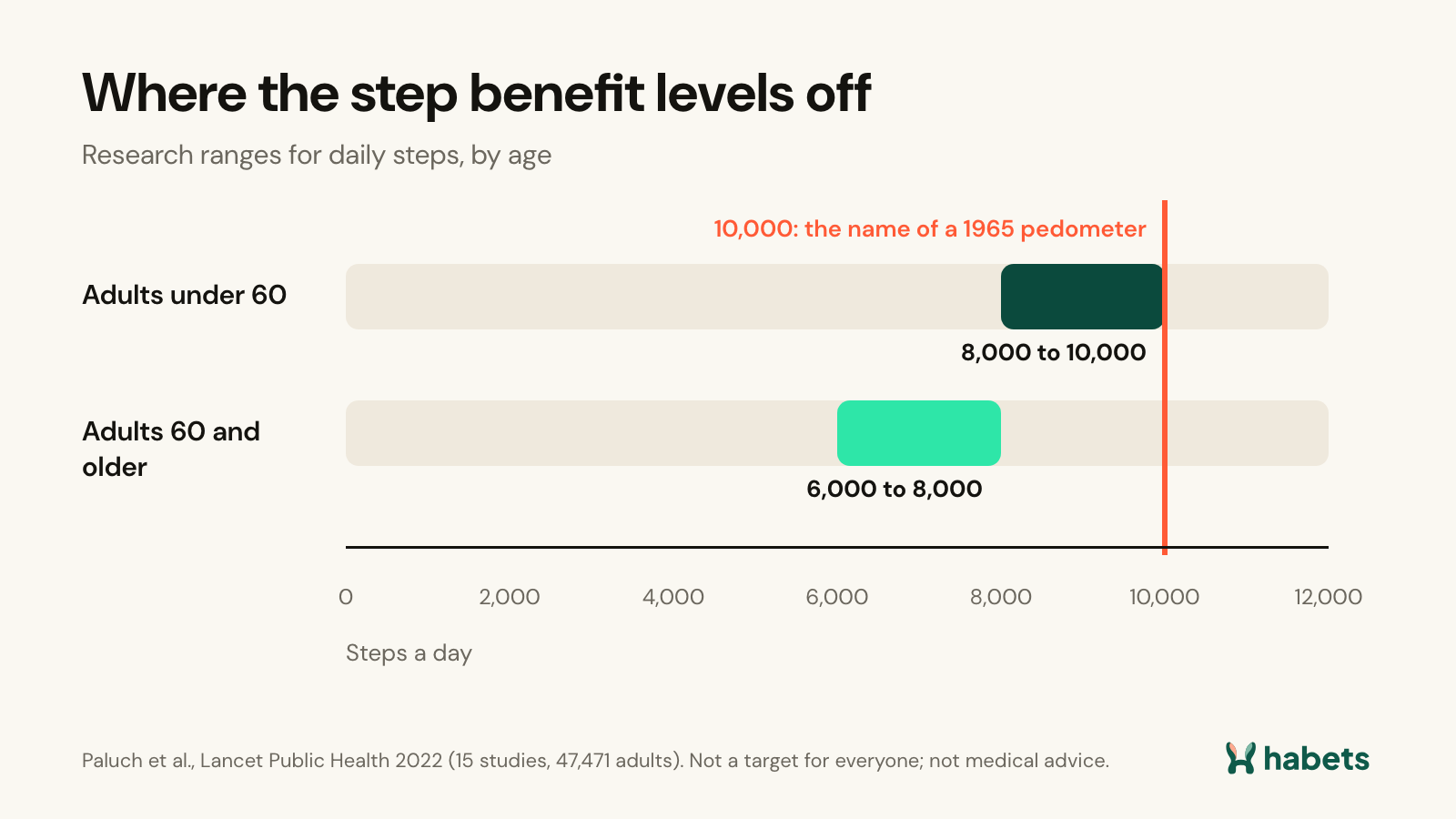
All three are observational. They show that people who walk more tend to have better outcomes, not that a specific number causes them. But together they move the goalposts in a useful direction.
So should you ignore 10,000?
Not exactly. The research supports three practical points.
- More is generally better, up to a point. None of these studies found harm from walking more. If you already walk 10,000 a day and enjoy it, keep going.
- The biggest difference is at the bottom. Going from very few steps to a moderate number is linked to the largest drop in risk. In Paluch's analysis, the group walking a median of 5,801 steps a day had a 40% lower risk than the group at 3,553.
- 10,000 is not a pass or fail line. If your normal day is 3,000 steps, a 10,000 target means failing every day for weeks. That is a bad way to build a habit.
Why a fixed 10,000 can backfire
Here is the habit problem with a one-size number. Goals work best when they are hard enough to matter and close enough to hit. A 2007 review in JAMA by Dena Bravata and colleagues found that pedometer users walked about 2,000 more steps a day than people without one, and that having a step goal was one of the key predictors of that increase. Goals work. But a goal you miss every day trains you to ignore it.
Most step counters do not care where you started. They light up at 10,000 and stay grey at 9,400. If you are building a walking habit, that grey ring every evening is a small message that you failed, repeated daily.
How to set a step goal you will actually keep
- Find your real baseline. Open your phone's health app and look at your average daily steps for the last two weeks. That is your starting point, not the number on the box.
- Add a modest amount. Around 1,000 to 2,000 steps a day above your baseline is a common, reachable step up. That is roughly 10 to 20 minutes of walking, depending on your pace. Our walking time calculator shows how long a given distance takes.
- Hold it for a few weeks. Keep the goal the same until hitting it feels routine. Then raise it.
- Use your age range as a long-term guide. For many adults that is somewhere between about 6,000 and 10,000, as the steps a day by age calculator shows.
- Attach the walk to a fixed moment. A goal is a number. A habit is a routine. A 10-minute walk after a meal you eat every day, on the same loop, does more for the habit than a long walk whenever you find time. Our guide on how to make a habit stick covers the routine side.
If you think better in distance than in steps, the steps to km and miles calculator converts one into the other. As a rough guide, 7,000 steps is about 2.8 to 3.5 miles (4.5 to 5.6 km), depending on your stride.
The bottom line
The 10,000-step goal is marketing that happened to point people in a healthy direction. The research behind daily steps is real, and it is kinder than the slogan: the biggest benefits are linked to moving up from a low base, and for many adults most of the measured benefit shows up around 7,000 steps. Pick a goal that starts from your own average and grows. That is the one you will still be walking in three months.
Habets is an app for building habits through challenges your phone can verify, and walking is one of the first habits it supports. The app is coming soon. Join the waitlist below to hear when it launches.
General information for healthy adults, not medical advice. If you have a health condition, ask your doctor what is right for you.
Questions people ask
Researchers trace it to a pedometer sold in Japan in 1965 called Manpo-kei, which roughly means '10,000-step meter'. It was a product name, not a number from a health study.
For many adults, research suggests most of the measured benefit is reached around there. A 2025 meta-analysis in The Lancet Public Health found that, compared with 2,000 steps a day, 7,000 steps was linked to a 47% lower risk of death, close to the figure for 10,000.
No. The studies do not show harm from walking more, and some outcomes kept improving past 7,000. The point is that 10,000 is not a pass or fail line, especially for people starting from a low base.
Start from your own average. Look at your last two weeks of steps, add a modest amount, around 1,000 to 2,000 a day, and keep that for a few weeks before raising it.

Build it with a little outside structure
Habets is an app for building habits through challenges your phone can verify: walking, sleep and the gym first, more later. Join the waitlist and we’ll tell you when it’s out.
We’ll only email you about the Habets launch. Unsubscribe anytime.
Sources
- Lee IM et al. Association of step volume and intensity with all-cause mortality in older women. JAMA Internal Medicine, 2019
- Paluch AE et al. Daily steps and all-cause mortality: a meta-analysis of 15 international cohorts. Lancet Public Health, 2022
- Ding D et al. Daily steps and health outcomes in adults: a systematic review and dose-response meta-analysis. Lancet Public Health, 2025
- University of Sydney. Rethink the 10,000 a day step goal, study suggests (2025)
- Tudor-Locke C et al. How many steps/day are enough? For adults. International Journal of Behavioral Nutrition and Physical Activity, 2011
- Bravata DM et al. Using pedometers to increase physical activity and improve health: a systematic review. JAMA, 2007